


Implantable Collamer Lens (ICL) for Myopia & Astigmatism
An alternative vision correction option for patients with high myopia, thin corneas, or those who may not be suitable for laser vision correction (LVC)
-
Corrects vision while preserving the natural lens and corneal tissue
-
The ICL can be removed or replaced if medically necessary.


What Is ICL Surgery?
-
ICL (Implantable Collamer Lens) is an implantable lens used to correct myopia and astigmatism while preserving the eye’s natural lens without removing corneal tissue
-
The foldable lens is inserted through a small 3-3.5 mm. corneal incision and positioned behind the iris and in front of the natural lens
-
ICL may be an option for patients with high myopia, thin corneas, or those who may not be suitable for Laser Vision Correction (LVC)
ICL Technology at TRSC
-
Implantable Collamer® Lens (ICL) is made from proprietary Collamer® material by STAAR Surgical, USA
-
Collamer® is designed for biocompatibility, optical clarity, flexibility, and UV filtration
-
Lens power and sizing are individually selected based on each patient’s eye measurements and refractive condition. At TRSC, we use the VuMAX™ HD UBM with ICLguru for detailed ophthalmic ultrasound imaging and precise ICL sizing.
Key Features of ICL Surgery
-
No Corneal Tissue Removal
Corrects vision without reshaping or removing corneal tissue -
Preserves the Natural Lens
The eye’s natural lens remains in place -
Removable or Replaceable
The ICL can be removed or replaced if medically necessary -
Small 3-3.5 mm Incision
The soft, foldable lens is inserted through a small corneal incision
How ICL Surgery Works
-
Small Incision: A small corneal incision is created to insert the foldable ICL
-
ICL Placemen: The lens unfolds inside the eye and is positioned behind the iris and in front of the natural lens
-
Natural Healing: The small incision is designed to heal without stitches
Benefits of ICL Surgery
-
Suitable for High Myopia
Provides a vision correction option for patients with high myopia who may not be suitable for certain laser procedures -
An Option for Thin Corneas
May be suitable for patients whose corneal thickness limits their laser vision correction options -
Alternative to Laser Vision Correction
Offers vision correction without permanently reshaping the cornea -
Preserves Future Treatment Flexibility
Since the natural lens remains in place and corneal tissue is not removed, future treatment options may remain available depending on the individual eye condition
ICL vs. LASIK: Which Vision Correction Option Is Right for You?

-
Lens availability varies by prescription and lens type, with a waiting period of approximately 1–2 months before surgery
-
At TRSC, ICL surgery is performed one eye at a time
-
The first eye is assessed before proceeding with the second eye

Who Is a Good Candidate for ICL Surgery?
You may be a suitable candidate if you:
-
Are 21–60 years old with a stable vision prescription
-
Have high myopia (more than −10.00 D) and/or astigmatism
-
Have thin corneas or are not suitable for certain laser vision correction procedures
-
Have sufficient anterior chamber depth
-
Have no eye conditions that may make ICL unsuitable, such as glaucoma, macular degeneration, or uveitis
-
Are not pregnant or breastfeeding
-
Have completed a comprehensive eye examination at TRSC and been confirmed as suitable by an ophthalmologist
-
Understand the procedure, expected outcomes, and limitations of ICL surgery
How to Prepare for Your ICL Preoperative Eye Examination
-
Stop wearing contact lenses before your examination and wear glasses instead:
-
Soft contact lenses: At least 3 days
-
Hard or semi-hard contact lenses: At least 14 days
-
Medication Preparation
-
Stop oral isotretinoin (e.g., Roaccutane, Acnotin, Isotret) for at least 1 month before your examination and surgery, as it may cause dryness of the ocular surface and cornea.
-
Inform your ophthalmologist about all medications you take including medication for diabetes, high blood pressure, cholesterol, thyroid conditions, and sleep. Regular medications may generally be continued unless otherwise advised.
-
Examination Time: Approximately 4 Hours
-
Your examination will be performed by the ophthalmologist who will perform your surgery. If you prefer a specific TRSC ophthalmologist, please schedule your examination with that doctor.
Your ICL Treatment Journey at TRSC
1. Comprehensive Eye Examination : Assess overall eye health, refractive condition, and suitability for ICL.
2. ICL Measurement & Lens Selection : Detailed eye measurements support personalized lens selection and treatment planning.
3. ICL Surgery : The selected ICL is implanted according to the treatment plan. One eye per time
4. Post-Operative Follow-Up : Follow-up examinations monitor healing, vision, and overall eye condition.
Why Choose TRSC for ICL Surgery?
-
Over 21 Years of ICL Experience and More Than 3,000 Eyes Treated
Specialist-led ICL assessment and treatment planning by ophthalmologists.
-
Comprehensive Preoperative Eye Assessment
Detailed evaluation to determine ICL suitability and support treatment planning.
-
Personalized ICL Planning
Lens power and sizing selected based on individual eye measurements and refractive condition.
-
Advanced Diagnostic Technology
VuMAX™ HD UBM with ICLguru supports detailed ophthalmic ultrasound imaging and precise ICL sizing.
-
Post-Operative Follow-Up Care
Ongoing follow-up to monitor recovery, vision, and overall eye health.
-
Dedicated Personal Counselor
Personalized support throughout your ICL treatment journey.
Limitations and Considerations of ICL Surgery
-
Lens availability varies by prescription and lens type, with a waiting period of approximately 1–2 months before surgery
-
At TRSC, ICL surgery is performed one eye at a time
-
The first eye is assessed before proceeding with the second eye

Frequently Asked Questions About ICL Surgery
-
How is ICL different from LASIK?
ICL uses an implantable lens to correct vision without removing corneal tissue, while LASIK reshapes the cornea using a laser.
-
Is ICL surgery painful?
Numbing eye drops are used during the procedure to minimize discomfort. Individual experiences may vary.
-
Who is suitable for ICL surgery?
ICL may be suitable for patients with high myopia, astigmatism, thin corneas, or those who are not suitable for certain laser vision correction procedures. A comprehensive eye examination is required to determine suitability.
-
Can an ICL be removed?
Yes. The ICL can be removed or replaced if medically necessary.
-
How long does ICL surgery take?
The procedure itself is relatively short. However, the total time at TRSC is approximately 5 hours per eye, including preoperative preparation and post-operative observation.
-
Can ICL correct astigmatism?
Yes. Toric ICL may be used to correct myopia with astigmatism, depending on individual suitability.
-
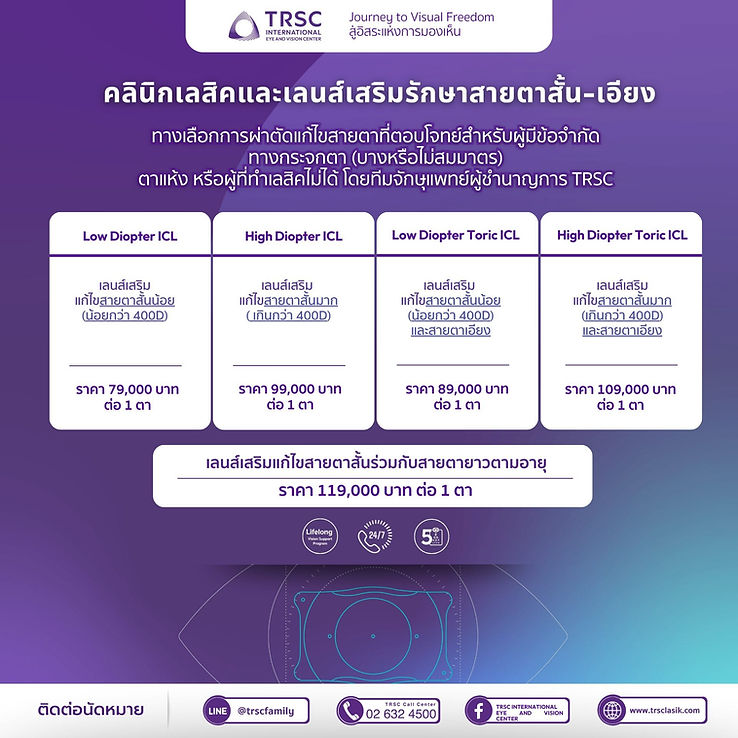
How much does ICL surgery cost at TRSC?
ICL surgery costs vary depending on the lens type and individual treatment plan. A comprehensive eye examination is required to determine the appropriate ICL and treatment cost.
-
How do I know if ICL or laser vision correction is right for me?
The most suitable option depends on your prescription, corneal condition, eye measurements, and lifestyle. A comprehensive eye examination at TRSC allows an ophthalmologist to recommend the appropriate vision correction option.

Meet Our ICL Surgery Specialists
Led by Dr. Pichit Naripthaphan, President of the Cataract and Refractive Surgery Club of Thailand under the Royal College of Ophthalmologists, alongside Dr. Chonthicha Charumalai and Dr. Patchima Chantaren.




Inquiries / Appointments

