


Super ReLEx (SMILE pro 2.0 or KLEx)
-
Minimally invasive, bladeless vision correction, developed from ReLEx SMILE.
-
Just 8–10 seconds of laser treatment — up to 3× faster than ReLEx SMILE.
-
Designed to minimize the risk of complications.
-
Intelligent guidance with OcuLign & CentraLign.
KLEx (Keratorefractive Lenticule Extraction) is a corneal refractive surgery technique that uses a femtosecond laser to separate corneal tissue into a lens-shaped piece called a lenticule.*


What Is Super ReLEx (SMILE pro 2.0 or KLEx) Laser Vision Correction?
-
Advanced small-incision vision correction with a 2–3 mm incision
-
Just 8–10 seconds of laser treatment
-
AI-assisted technology for precise treatment alignment
Super ReLEx (SMILE pro 2.0 or KLEx) Technology
-
VISUMAX 800 Femtosecond Laser by ZEISS, Germany
-
OcuLign & CentraLign Intelligent Guidance in SMILE pro 2.0
-
Small-Incision, Flap-Free Technique
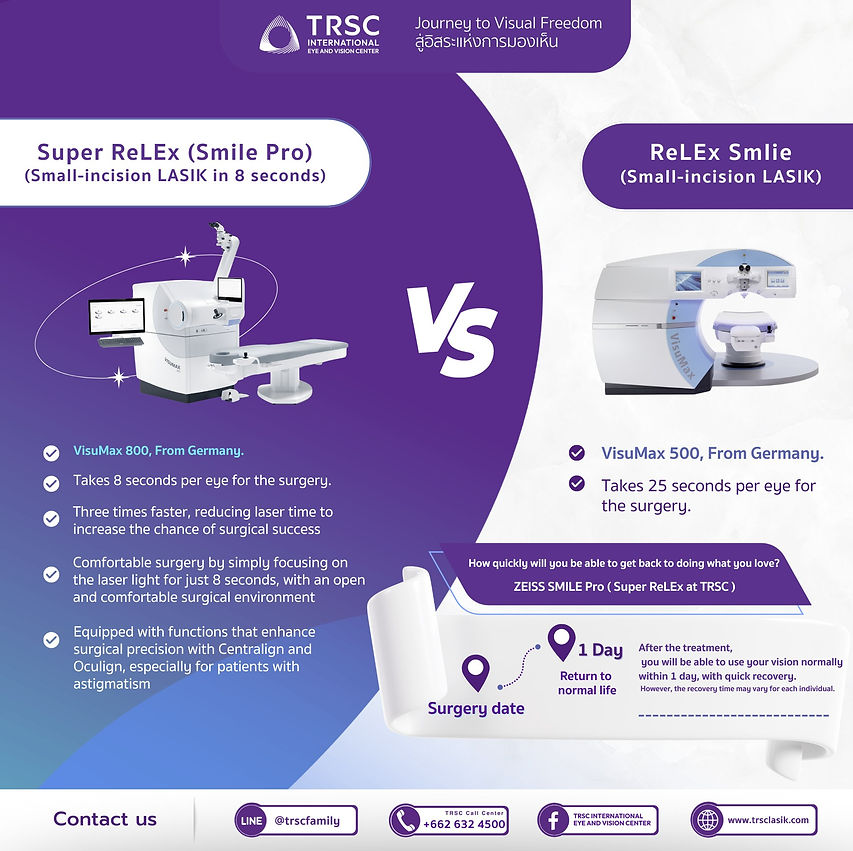
Key Features of Super ReLEx (SMILE pro 2.0 or KLEx)
-
8–10 second laser treatment — up to 3× faster than ReLEx SMILE
-
Fast visual recovery with high-quality vision
-
Small-incision, flap-free treatment
How Super ReLEx (SMILE pro 2.0 or KLEx) Works
-
Creates a precise lenticule with the VISUMAX 800
-
Creates a small 2–3 mm. incision without a corneal flap
-
Removes the lenticule to reshape the cornea
Benefits of Super ReLEx (SMILE pro 2.0 or KLEx)
-
Small incision, No corneal flap
-
Fast visual recovery
-
High treatment precision with less need for future laser enhancement
-
Lower risk of dry eye and night-vision disturbances
-
Corrects myopia and astigmatism up to −13.00 D
-
Bladeless, all-laser procedure
-
Minimal discomfort during treatment
Limitations of Super ReLEx (SMILE pro 2.0 or KLEx)
-
Super ReLEx (SMILE Pro 2.0) is not currently suitable for correcting hyperopia (farsightedness)


Technology comparison

Who Is a Good Candidate for Super ReLEx (SMILE pro 2.0 or KLEx) at TRSC?
You may be a suitable candidate if you:
-
Are 18 years or older with a stable vision prescription for at least 1 year
-
Have healthy corneas and overall eye health
-
Have no severe dry eye, keratoconus, retinal disease, or other eye conditions that may affect treatment
-
Have no uncontrolled medical or autoimmune conditions that may affect healing, such as SLE, Sjögren’s syndrome, psoriasis, or uncontrolled diabetes
-
Are not pregnant or breastfeeding
-
Are not currently taking medications for psychiatric conditions
-
Have completed a comprehensive eye examination at TRSC and been confirmed as suitable by an ophthalmologist
-
Understand the procedure, expected outcomes, and limitations of Super ReLEx
For patients under 20: A parent or legal guardian must accompany you on the day of surgery to provide consent. Surgery may be postponed if consent requirements are not met.
How to Prepare for Your Super ReLEx Preoperative Eye Examination
-
Stop wearing contact lenses before your examination and wear glasses instead:
-
Soft contact lenses: At least 3 days
-
Hard or semi-hard contact lenses: At least 14 days
-
-
Medication Preparation
-
Stop oral isotretinoin (e.g., Roaccutane, Acnotin, Isotret) for at least 1 month before your examination and surgery, as it may cause dryness of the ocular surface and cornea.
-
Inform your ophthalmologist about all medications you take including medication for diabetes, high blood pressure, cholesterol, thyroid conditions, and sleep. Regular medications may generally be continued unless otherwise advised.
-
Avoid alcohol, sedating medications, and sleeping pills for 1 day before your examination, unless medically prescribed or otherwise advised by your doctor.
-
-
On the Day of Your Examination
-
Examination Time: Approximately 3.5 hours.
-
Do Not Drive: Dilating eye drops may cause blurred near vision and increased light sensitivity for approximately 4–6 hours.
-
Examination Validity: Your examination results are valid for 90 days.
-
Your Ophthalmologist: Your preoperative examination and surgery will be performed by the same ophthalmologist. If you prefer a specific TRSC ophthalmologist, please schedule your examination with that doctor.
-
-
What Happens After Your Eye Examination?
Your ophthalmologist will determine one of three possible outcomes:
1. Suitable for Super ReLEx
Your eyes are healthy and suitable for treatment. Surgery can be scheduled according to your preferred date and your ophthalmologist's recommendation.
2. Another Treatment May Be More Suitable
If Super ReLEx is not suitable for your eyes or overall health, your ophthalmologist may recommend alternatives such as PRK or ICL (Implantable Collamer Lens).
3. Further Treatment or Evaluation Is Needed
Conditions such as dry eye, contact lens-related inflammation, retinal concerns, or suspected glaucoma may need to be treated or evaluated before Super ReLEx can be considered.
Frequently Asked Questions About Super ReLEx (SMILE pro 2.0 or KLEx)
-
How is Super ReLEx different from ReLEx SMILE?
Super ReLEx uses the VISUMAX 800, with a laser treatment time of just 8–10 seconds — up to 3× faster than ReLEx SMILE. The shorter treatment time is designed to enhance patient comfort and treatment efficiency.
-
Is Super ReLEx painful?
The procedure is designed for minimal discomfort. Numbing eye drops and anti-anxiety medication are provided, and numbness is checked before treatment.
-
How long is the recovery after Super ReLEx?
Most patients can resume normal visual activities the next day, depending on individual recovery. Avoid getting water in the eyes for 3 days and follow your ophthalmologist’s postoperative instructions.
-
Can my vision become blurry again after Super ReLEx?
Vision may change over time due to aging or prescription changes. Laser enhancement may be considered after an ophthalmologist’s assessment.
-
KLEx and SMILE pro the same?
KLEx is a general term for a type of refractive surgery that involves the removal of a lenticule from the cornea, while SMILE pro is a specific surgical technology or technique that uses this approach, with its own laser system and procedure-specific features.




Inquiries / Appointments

